Multifamily underwriting is the process of evaluating an apartment property's financial performance to determine whether it meets your investment criteria. The analyst tests income, expenses, debt coverage, and market conditions to calculate expected returns and assess risk. In 2026, the bar for that analysis keeps rising. Lender scrutiny, shifting tenant demand, and volatility in operating costs mean the model needs to be structured, consistent, and easy to defend in front of an investment committee.
A strong underwriting package starts with clean data and ends with a clear recommendation. Between those two points, the analyst builds a proforma, pressures every assumption, and models how returns flow back to the sponsor and its capital partners. Each step has its own discipline.
What Multifamily Underwriting Means in Practice
At its core, multifamily underwriting is feasibility analysis. It answers whether a specific asset, at a specific price, under a specific set of operating assumptions, can deliver the returns an investor requires. The work is detailed by nature. Thorough underwriting dissects a property into its fundamental financial and operational elements rather than treating the building as a single lump of income and expense.
Two parts shape most of the analysis: the historical record and the forward-looking plan. The trailing twelve-month financials show how the property has actually performed. The proforma shows how it could perform under renovation, lease-up, or repositioning. When the two are stacked side by side, the gap between current operations and projected operations becomes the entire investment thesis.
Standardize the Data Before You Underwrite the Deal
Professionals who underwrite deals regularly stress one point: the underwriting framework should not change much from property to property. Standardize all data, create clean reports, and keep the format consistent from one deal to the next. If the model is rebuilt every time a new offering memorandum arrives, comparisons become unreliable and mistakes hide inside deal-specific customizations.
Standardization is also a comparison tool. When two apartment deals are underwritten with the same structure, the analyst can put them side by side and see which one actually meets the stated investment criteria. Property management systems such as Yardi, RealPage, and Entrata generate rent rolls and statements in different layouts, so teams increasingly automate the parsing of that data into one consistent format before modeling begins.
Assemble the Core Underwriting Documents
Modeling starts with the property's raw evidence. The documents required to underwrite a multifamily deal fit into four categories, led by the offering memorandum, the rent roll, and the trailing twelve-month financial statements.
The offering memorandum is the seller's presentation of the asset, the business plan, and the market story. The rent roll is the tenant-level record of the building: unit types, square footage, monthly rent, concessions, and occupancy. The trailing twelve-month statements capture actual operating history for revenue and expenses. Together they form the raw material for every projection that follows.
The quality of these documents determines the quality of the analysis. A rent roll that does not reconcile to the operating statements, or a twelve-month history with gaps, forces the underwriter to make assumptions that may not hold. Agency lending standards also apply. Fannie Mae's multifamily underwriting guidance, for example, requires support for the income projections used to determine the aggregate amount of the mortgage loan. A complete document package makes that support much easier to provide.
Build the Proforma in Layers
A proforma is the forward-looking financial heart of the underwriting package. It converts the offering memorandum narrative and the historical operating statements into a structured, year-by-year projection of income, expenses, debt service, and returns. In a value-add deal, the proforma carries even more weight because the purchase price is built on projected performance after renovation and lease-up, not just on what the building produces today. Building the model in layers keeps the logic transparent and reviewable.
Income projections start with the rent roll
The rent roll anchors the income side of the proforma. Current in-place rents, lease expirations, concessions, and unit mix feed directly into a projection of future rental revenue. From there, the underwriter applies assumptions about market rent growth, vacancy, and collection loss. Lenders want to see support for those income projections, which means every assumption should tie back to market evidence or a documented business plan rather than a plug number.
For a value-add underwrite, the income projection usually includes a second layer: rents after renovation. The model must capture the timing of unit turns, downtime during construction, and the pace of lease-up so revenue is not overstated in the early years.
Expenses, vacancy, and capital items
Operating expenses rarely receive the same attention as rental income, but they determine how much of that income the property keeps. The underwriter starts with the expense lines in the trailing twelve-month statements and then adjusts for management fees, property taxes, insurance, utilities, repairs, and replacement reserves. Expense assumptions that fall far below the property's own history should trigger questions.
Capital items matter just as much. Deferred maintenance, unit renovation costs, and structural repairs appear in the proforma as one-time outlays, and they must be timed correctly against the income uplift they are supposed to create.
Debt service and return metrics
Debt service connects property operations to the capital structure. The underwriter tests whether projected net operating income can cover the proposed mortgage payments and how much cushion remains if occupancy or rents soften. Debt coverage is a standard screen for lenders and equity investors, so the proforma needs to show it clearly across the projection period.
Return metrics sit on top of debt service. Expected returns are measured against the equity invested, the projected cash flow, and the eventual sale or refinance proceeds. Because those returns depend on assumptions made years into the future, the proforma should be tested with sensitivities that show how the deal performs if rent growth slows, expenses rise, or exit conditions move.
Waterfall Models: Underwrite the Distribution, Not Just the Property
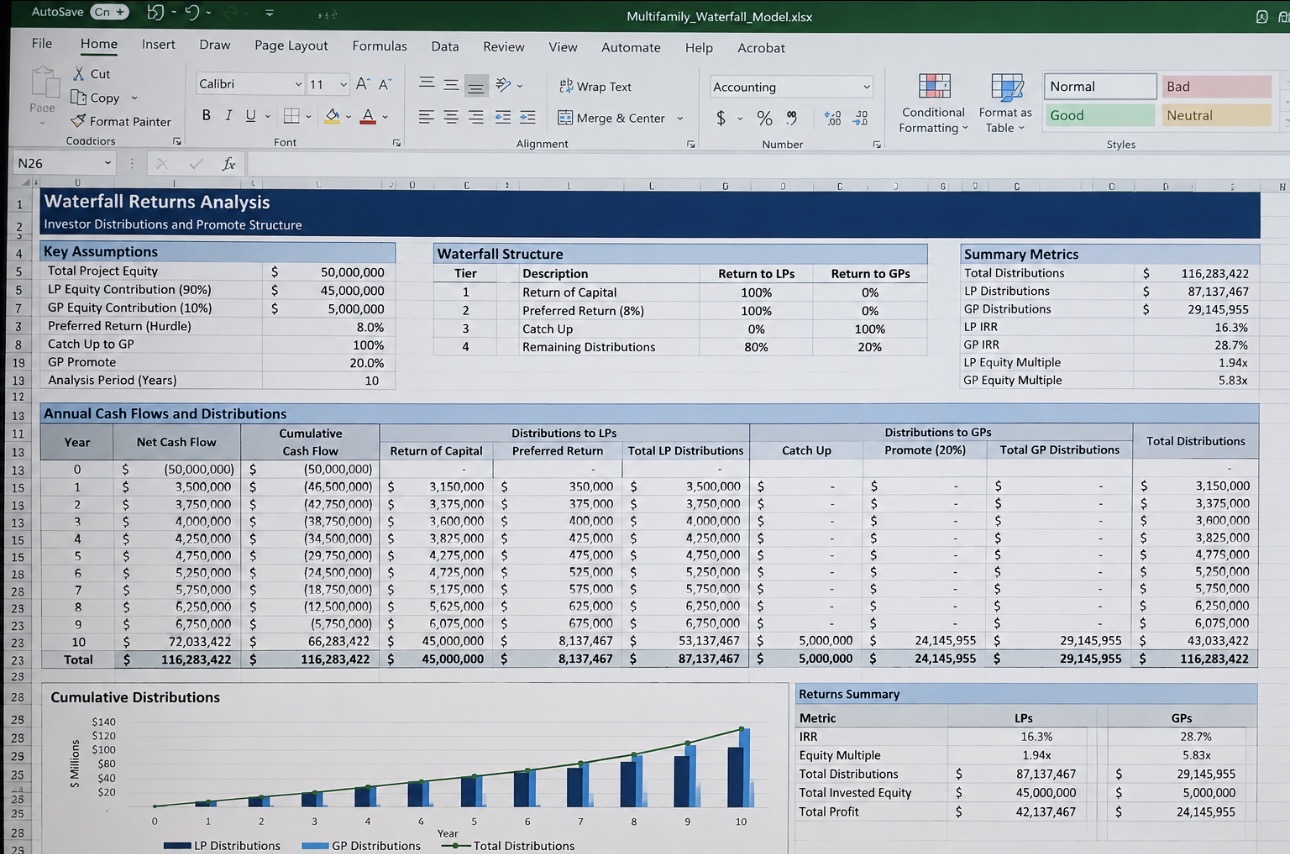
Once the property-level proforma is complete, the next question is who receives the returns. A waterfall model defines how cash flow and disposition proceeds are distributed between the sponsor and its capital partners at different performance levels. The structure typically works in tiers, with profits shifting toward the sponsor once return thresholds are cleared.
In institutional multifamily investing, the waterfall is not a minor appendage to the deal. Two investors can look at the same property-level return and end up with very different economics depending on how the distribution is structured. The underwriting model should therefore show both views: the total return to the partnership and the return allocated to each partner class. Sensitivity analysis becomes especially useful at this stage because a return that barely clears a waterfall threshold can change the sponsor's economics quickly when assumptions move.
Watch for Red Flags in Underwriting Assumptions
Underwriting assumptions are where deals succeed or fail, which is why they attract the most scrutiny. A red flag is any assumption that points in only one direction or cannot be supported by the documents in hand. Aggressive market rent growth without lease comparables, expenses projected below the property's own operating history, and occupancy assumptions that ignore upcoming lease expirations all deserve a closer look.
The remedies are straightforward. Compare the proforma to the trailing twelve-month figures line by line. Ask the sponsor or broker to support every material assumption. Then run sensitivities to see which inputs move the return the most. When a single optimistic assumption is responsible for the deal's viability, the model is telling you something important.
Make the Process Repeatable
Because multifamily underwriting follows a consistent logic, it can be organized into a repeatable workflow. Many practitioners describe it as a seven-step process that starts with the document package and ends with a tested investment recommendation. A dependable version of that process looks like this:
- Collect the offering memorandum, rent roll, and trailing twelve-month financial statements.
- Standardize all data into one clean format so deals can be compared.
- Reconcile the rent roll against the operating statements.
- Set forward-looking assumptions for income, expenses, vacancy, and capital items.
- Build the proforma and layer in debt service.
- Model the waterfall and the resulting sponsor and investor returns.
- Run sensitivities and document the conclusions.
A process defined this tightly has an added benefit. When the method stays constant from deal to deal, the output is easy to audit, easy to compare, and easy to defend. That is exactly what an investment committee expects from a multifamily underwriting package in 2026.
Frequently Asked Questions
What documents do you need to underwrite a multifamily deal?
The documents required for a multifamily underwrite fit into four categories, including the offering memorandum, the rent roll, and the trailing twelve-month financial statements. These provide the market narrative, the tenant-level revenue picture, and the historical operating record used to build income and expense projections. Lenders such as Fannie Mae require support for income projections, so complete documentation is essential.
Why should underwriting stay the same from deal to deal?
Consistency makes comparisons reliable. When you standardize all data and create clean reports, you can underwrite two deals side by side and see which one actually meets your investment criteria. If the format and assumptions shift for each property, the analysis becomes harder to audit and small errors are easier to hide. A stable process protects the quality of the decision.
What is the role of the proforma in value-add underwriting?
The proforma projects how a property will perform after the planned business plan is executed. In value-add deals, that means modeling renovation costs, unit downtime, lease-up pace, and post-renovation rents alongside operating expenses and debt service. Because the purchase decision depends on future performance, the proforma must show the full path from current operations to stabilized operations.
What is a waterfall model in multifamily underwriting?
A waterfall model sets the order and proportion in which cash flow and sale proceeds are distributed between the sponsor and its capital partners. It typically works in tiers, with profits shifting toward the sponsor once return thresholds are reached. Underwriting only the property-level return is not enough; the model should also show how the waterfall allocates results at different performance levels.