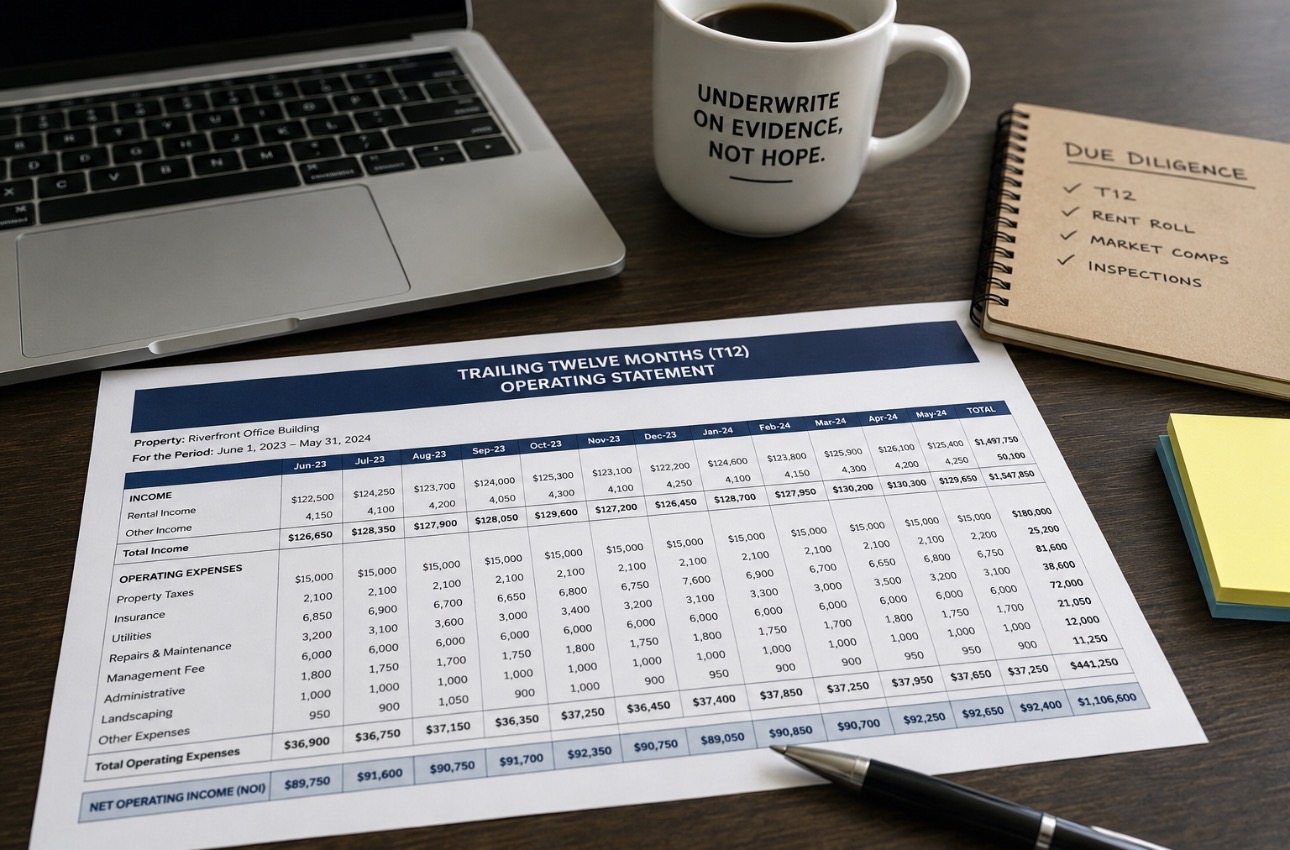
A T12 is one of the first documents a buyer, lender, or analyst requests when evaluating an income-producing property. Short for trailing twelve months, the T12 is a financial statement that shows a property's actual income and expenses over the most recent 12-month period. Because it reflects what really happened at the property rather than what someone hopes will happen, it anchors most commercial real estate underwriting decisions. This walkthrough explains what the T12 contains, why it matters, and how to read one carefully before you rely on it in a deal.
What Is a T12 in Real Estate?
A T12, sometimes written as T-12, is short for "Trailing Twelve Financials." In real estate, it is a trailing 12-month operating statement that lays out a property's actual income and expenses, broken out by month, for the preceding year. The same document is often called a trailing 12-month profit and loss statement because it behaves like a P&L for the property's most recent full year of operations.
The key word is actual. A pro forma projects what a property might earn under new ownership, new rents, or new management. The T12 shows what the property actually produced. That makes it the single most important document for determining a property's real operating performance, as opposed to a projection of future results. Lenders, buyers, and passive investors all lean on the T12 during due diligence to value a property and catch problems before money changes hands. In practice, the T12 is the starting point for nearly every commercial real estate financial analysis.
What Does a T12 Statement Contain?
Most T12 statements share the same basic anatomy. They list income first, then operating expenses, and then show the resulting net operating income for the property over the trailing period.
- Actual income and expenses for the preceding twelve months
- A month-by-month breakdown for each period in the year
- Rental income and other income produced by the property
- Operating expenses required to keep the property running
- Net operating income that summarizes the economic performance of the property over the past twelve months
Because the T12 summarizes property performance based on NOI over the trailing twelve months, the monthly schedule is critical. It lets you check whether the property is stable from month to month or whether one unusual month is carrying the result. A single annual total can hide that kind of detail, which is why the monthly columns matter as much as the bottom line.

How to Read a T12 Step by Step
Reading a T12 is a routine part of due diligence, but it deserves discipline. Use the steps below to verify what the statement says and what it does not say. Each step builds on the last one.
Step 1: Confirm the Reporting Period
A trailing twelve month statement is only meaningful if you know exactly which twelve months it covers. Check the start and end dates on the report and confirm that the final month is the most recent month available. The T12 should reflect the property's actual operations over the most recent full year. Older financials can be clean but stale, and a statement that ends months before the current date will not give you an accurate picture of where the property stands today.
Step 2: Start with the Income Lines
The income section sits at the top of the statement. Review the rental income and any other property-level income to understand how much revenue the property produced each month. Scan across the monthly columns and note any months where income appears low or unusually high. A sharp drop may point to vacancy, turnover, or rent loss, while a single strong month should not be treated as the new normal. The income lines are the foundation for everything else in the analysis.
Step 3: Work Through the Operating Expenses
Operating expenses sit below income and represent what it costs to run the property. Read the expense lines the same way you read the income lines. Do the costs stay consistent across the twelve months, or does one month contain a large item that appears nowhere else? Expenses that cluster in a single period can distort the property's true operating costs, so identify them early rather than accepting the annual total at face value. The goal is to understand the recurring cost of operating the property, not just the total shown on the report.
Step 4: Verify the Net Operating Income
Net operating income is the number that summarizes the economic performance of the property for the trailing twelve months. NOI is calculated from the income left after operating expenses are removed, and it is the figure most closely tied to how a property is valued. Confirm that the stated NOI is consistent with the income and expense lines above it. If the monthly columns do not add up to the totals on the statement, that mismatch is a reason to request a corrected version before relying on the document.
Step 5: Reconcile the T12 with the Rent Roll
The T12 does not stand alone. During due diligence, analysts reconcile the T12 with the rent roll to confirm that the income reported on the operating statement matches the rent documented for each unit. When the two documents disagree, the rent roll usually provides the unit-level detail needed to explain the difference. A T12 that cannot be reconciled to the rent roll is a major concern. This cross-check is one of the most important protection steps in the entire underwriting process.
T12 vs. T3 vs. YTD: Know the Difference
Real estate operators use different reporting windows for different purposes. The differences come down to the time period each report covers and the job it is asked to do.
| Report Type | Period Covered | Typical Use |
|---|---|---|
| T12 | Trailing twelve months | Full-year operating performance and valuation |
| T3 | Trailing three months | Recent momentum and short-term changes |
| YTD | Current calendar year to date | Performance against the current year's budget |
The T12 is the stronger underwriting foundation because it captures a full annual cycle. Seasonal costs, slow rental months, and one-time items all appear within a twelve-month window in a way they do not in a three-month or partial-year report. Investors may still request T3 and YTD numbers for a fresh read on recent activity, but the T12 anchors the valuation because it reflects an entire year of actual operations.
Red Flags to Watch For in a T12
A clean operating history and a fabricated one can look similar at first glance. The red flags are often found in the small details of the monthly columns. Watch for signs that the statement is incomplete, inconsistent, or built to tell a specific story.
- Months that appear to be missing or duplicated in the schedule
- Large expenses confined to a single month with no explanation
- Income that cannot be matched to the rent roll
- Numbers that look rounded or estimated rather than drawn from property records
- A reported NOI that cannot be reproduced from the monthly columns
- A statement that ends more than a month or two before the current date
Any of these signals should prompt follow-up questions before the deal moves forward. A T12 is only useful when it can be trusted as an accurate record of what happened at the property.
Reading a T12 is a skill every real estate professional can build with repetition. Check the period, read the income and expense lines, verify the NOI, reconcile the statement with the rent roll, and document anything that looks unusual. A careful review of the actual operating history is the difference between underwriting a property on evidence and underwriting it on hope.
Frequently Asked Questions
These are the most common questions analysts ask when they start reviewing T12 statements for a potential deal.
What does T12 stand for in real estate?
T12 stands for trailing twelve months. Real estate professionals also call it the T-12 or trailing twelve financials. The label describes a financial statement that shows actual income and expenses for the most recent twelve month period, broken out by month. Buyers, lenders, and investors use it to evaluate a property's true operating performance rather than relying on projected future numbers.
What is the difference between a T12 and a profit and loss statement?
A T12 is essentially a trailing 12-month profit and loss statement for a property. Many professionals use the terms interchangeably because both documents show income and operating expenses. The difference is timing and purpose. A standard P&L can cover any period a manager chooses, while a T12 specifically covers the most recent twelve months and is used for valuation and due diligence.
Should I use a T12 or a pro forma?
You should review both, but each one serves a different job. The T12 shows the property's actual operating history over the past year, while a pro forma projects future performance based on assumptions. The T12 anchors the analysis because it reflects real income and real operating costs. Use the pro forma to test what could change, not to replace the evidence in the T12.
Why does NOI matter when reading a T12?
Net operating income summarizes the economic performance of the property over the trailing twelve months. When buyers value a property, they look closely at a defensible NOI figure because it represents the income left after operating expenses. An overstated NOI can come from understated expenses or inflated income, so always verify the NOI against the line items and the rent roll before relying on it.